30 Kitchen Coffee Station Ideas in 2027 (Small Spaces, Modern Nooks & Stylish Coffee Bars)
Discover 30 practical, beautiful kitchen coffee station ideas for 2027—from compact countertop trays and slim rolling carts to concealed appliance garages and boutique home cafes.
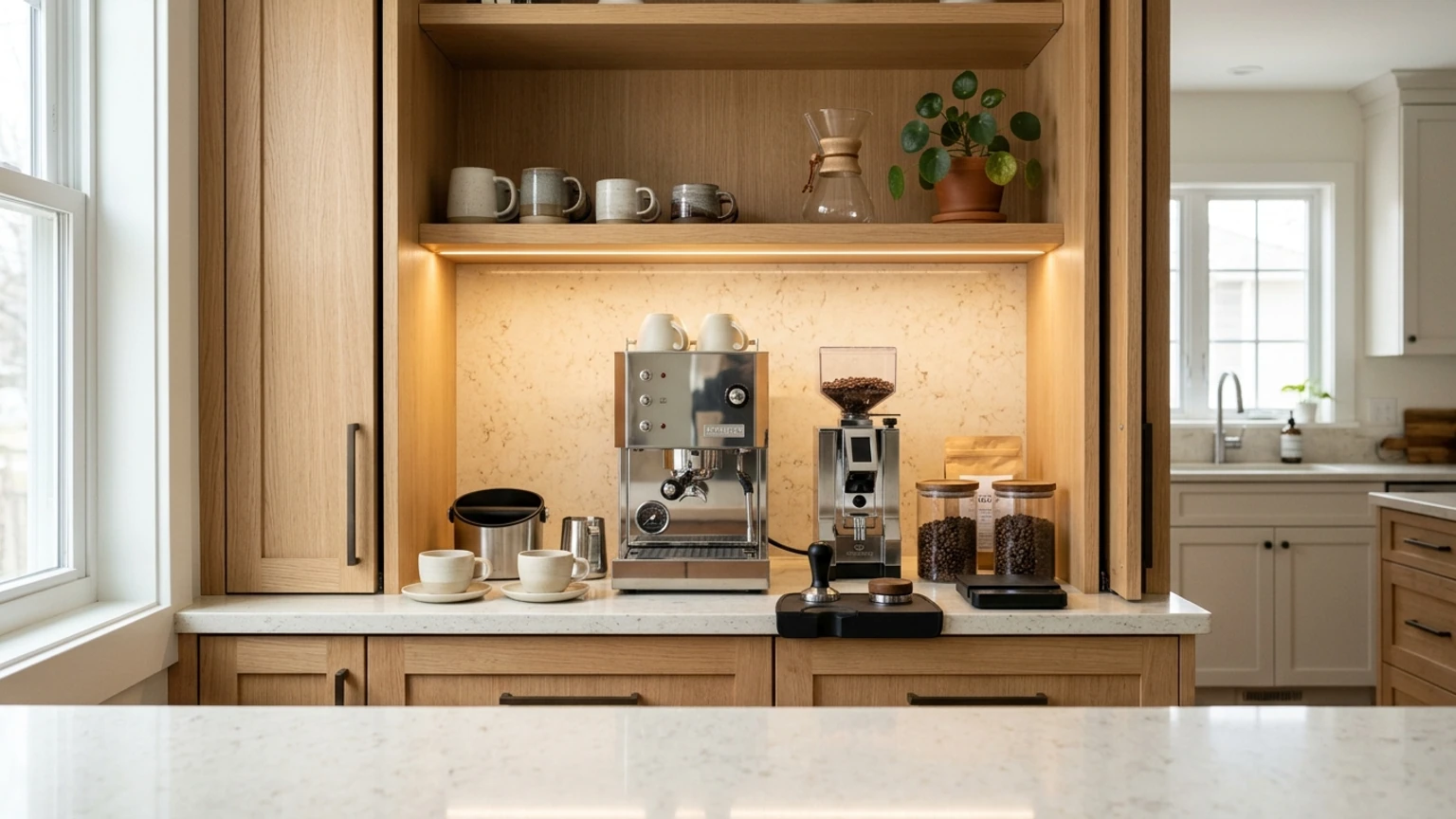
Why Dedicated Beverage Stations Are the Smart Kitchen Move for 2027
A great kitchen coffee station makes your morning routine simpler—not more complicated. Whether you have room for a built-in espresso bar or only a few inches of usable counter, the right setup keeps your brewer, mugs, and everyday supplies in one easy-to-reach place.
Looking ahead to 2027, dedicated beverage zones are a practical design direction, not just a decorative trend. The National Kitchen & Bath Association's 2027 Kitchen Trends Report found that 90% of surveyed kitchen industry professionals expected dedicated beverage areas to be popular over the next three years. Pinterest's 2026 Hobbies Trend Report also identified growing interest in home cafés and vintage coffee corners. Those findings provide context; they do not mean every kitchen needs a costly renovation.
Below are 30 kitchen coffee station ideas for 2027, from renter-friendly countertop arrangements to concealed cabinets and warm, character-filled coffee nooks. Each includes a concrete setup tip so you can recreate the look in a real kitchen.
Which Coffee Station Is Right for Your Kitchen?
| Your space or priority | Start with | Why it fits |
|---|---|---|
| Very little counter space | Ideas 1, 2, 4, 8 | Small footprint, simple storage |
| Rented apartment | Ideas 3, 5, 10, 29 | Minimal permanent changes |
| Prefer clutter hidden away | Ideas 7, 11, 13, 14 | Closed storage and clear counters |
| Planning a remodel | Ideas 12, 15, 16, 18 | Cabinetry designed around your routine |
| Love decorating | Ideas 21–29 | Strong visual style without needing a major build |
| Entertain regularly | Ideas 16, 20, 30 | Easy service for more than one person |
Before you choose: Measure the actual machine, including the space needed to open its lid, refill the tank, pull out the drip tray, and release steam. Put the station near an appropriate outlet and a convenient cleanup spot. Follow the appliance manual for countertop and ventilation clearances; consult a qualified electrician before adding outlets or changing cabinet wiring. Avoid cords stretched across walkways and keep hot machines out of closed, unventilated cabinets during operation.
The One-Tray Countertop Coffee Station
A tray can make an ordinary stretch of counter feel like a planned coffee nook. Choose one with a washable surface and a low rim, then group the sugar jar, teaspoons, and everyday mugs beside your brewer. Keep the machine itself on a stable countertop if its weight, heat, or footprint makes the tray unsuitable. The goal is a visual boundary, not a miniature display crowded with accessories.
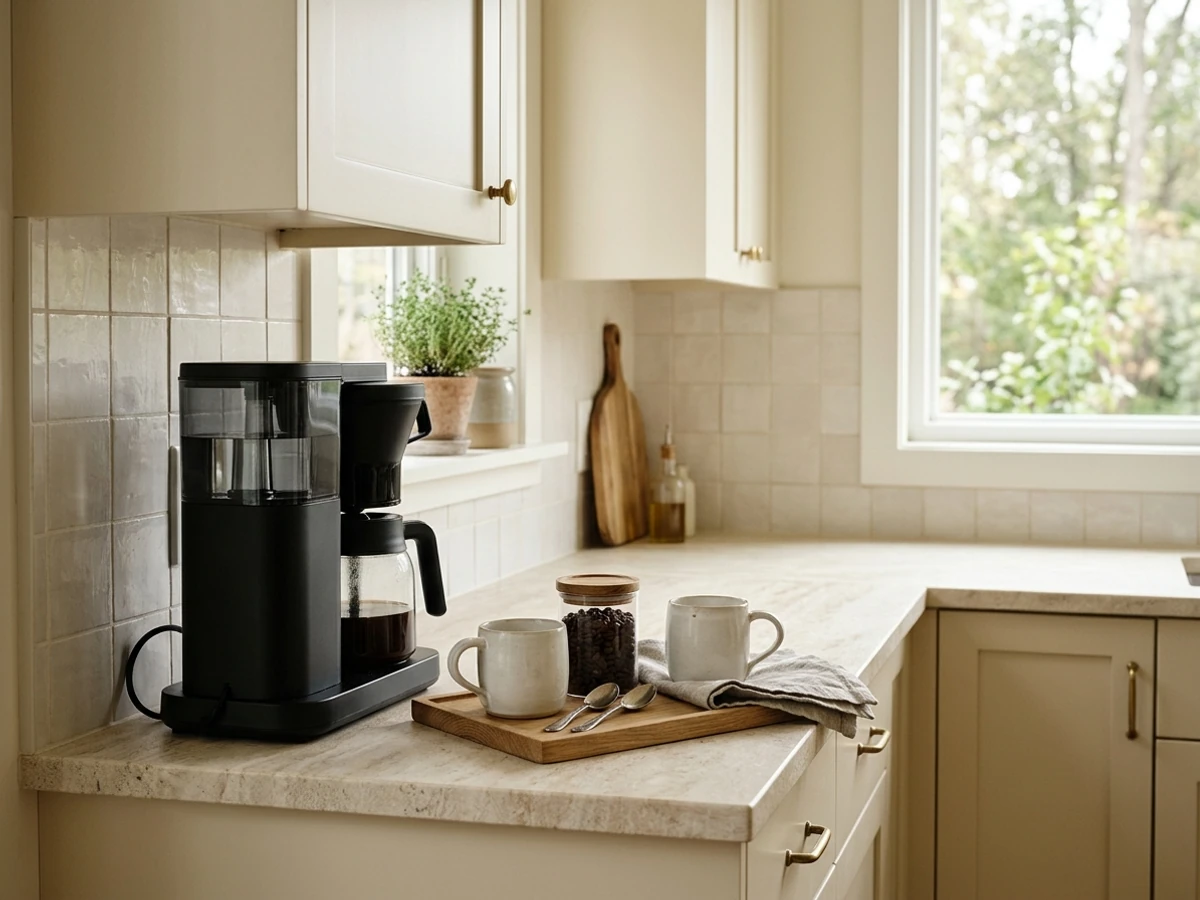
Idea 1: The One-Tray Countertop Coffee Station — corralling spoons, beans, and daily mugs onto a single washable tray.
The Forgotten Corner Coffee Nook
An awkward L-shaped countertop corner often collects mail or rarely used gadgets. Give it a single job: coffee. Position the machine where you can still lift the water tank or reach the buttons, then tuck jars and mugs to the side rather than behind it. An angled wooden board or small lazy Susan can corral lightweight supplies without making the machine harder to use.

Idea 2: The Forgotten Corner Coffee Nook — maximizing awkward corner counter space with an organized rotating turntable.
The Slim Rolling Coffee Cart
A narrow rolling cart creates a dedicated station when the counters are already full. Put sealed beans, filters, cups, and napkins on the lower shelves; keep a lightweight, manual brewing setup on top. A cart is particularly useful beside a breakfast table because it can move out of the way after serving. For electric equipment, use it only where the cart is stable, parked, and safely located near a suitable outlet.

Idea 3: The Slim Rolling Coffee Cart — tiered vertical storage on locking casters for small kitchens.
A Mug Rail Above the Brewer
A simple row of mug hooks puts your favorite cups within reach while freeing cabinet space. Mount the hooks beneath a properly secured shelf, or use an existing rail system. Limit the display to a few cups that you actually use; a crowded wall can make a small kitchen feel busier. The brewer stays on the counter below, where it is easy to fill, clean, and unplug.

Idea 4: A Mug Rail Above the Brewer — brass under-shelf hooks keeping favorite ceramic mugs off the counter.
A Window-Side Morning Coffee Spot
Placing the station near a kitchen window gives everyday brewing a pleasant backdrop without adding more décor. A small carafe, one plant that tolerates the light, and two mugs can be enough. Choose a location where sunlight will not overheat stored beans or turn an electrical outlet into a splash zone. Keep coffee supplies in a closed cabinet or opaque container if the spot gets strong afternoon sun.

Idea 5: A Window-Side Morning Coffee Spot — gentle daylight illuminating an uncluttered morning prep station.
The Under-Cabinet Lighted Station
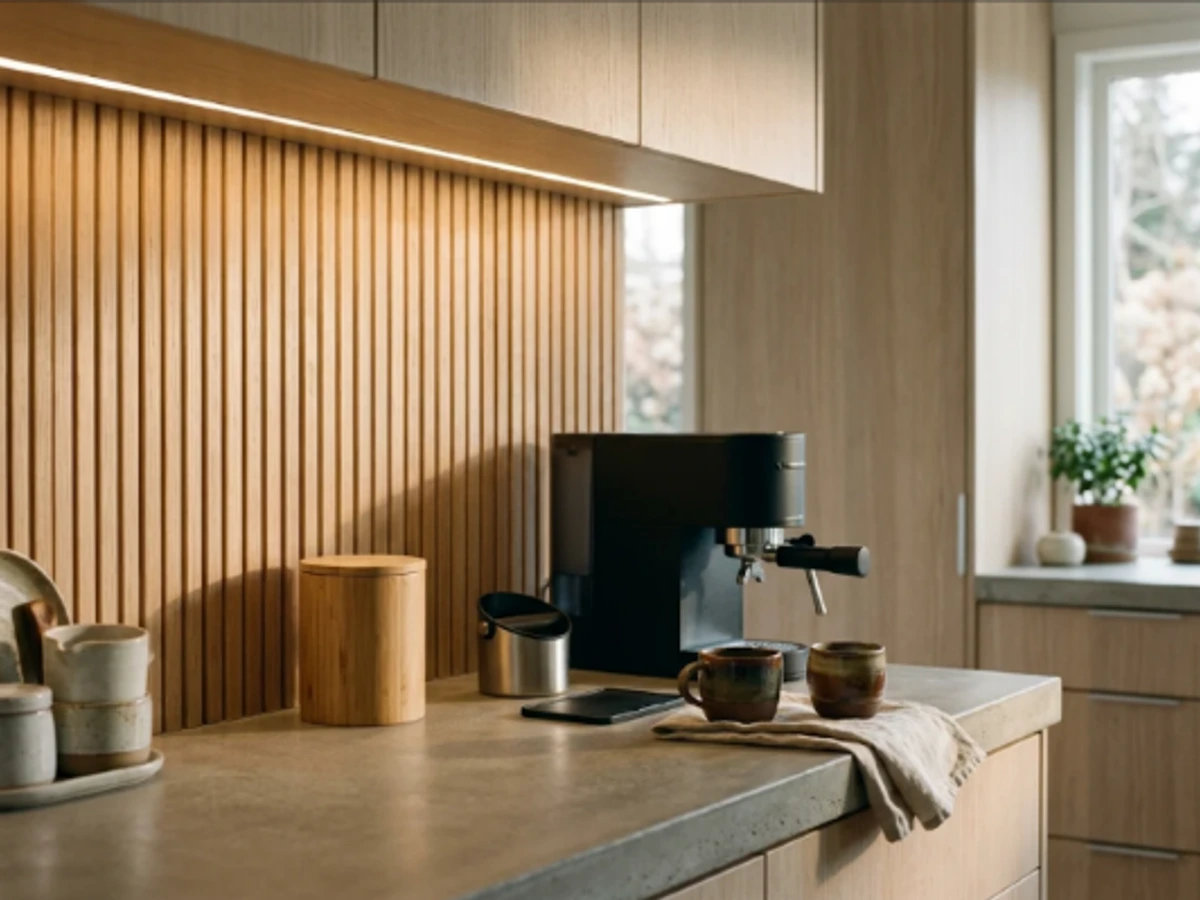
Task lighting makes a tiny coffee area easier to use, particularly during dark winter mornings. A slim, properly installed under-cabinet light can illuminate scoop marks, grinder settings, and the work surface without relying on a harsh ceiling fixture. Keep the shelf above understated so the glow becomes the feature. Warm-toned lighting pairs especially well with wood, cream, and stone.

Idea 6: The Under-Cabinet Lighted Station — warm 2700K task illumination highlighting countertops and grinder dials.
The Pantry Pull-Out Supply Shelf
If you already have a nearby pantry, reserve a pull-out shelf for the pieces that make coffee service messy: filters, spare capsules, syrups, stirrers, and cleaning cloths. The machine remains on a safe counter, while the supplies disappear after the morning rush. Dividers keep small packets from sliding to the back, and the pull-out surface makes even a deep cabinet easy to access.
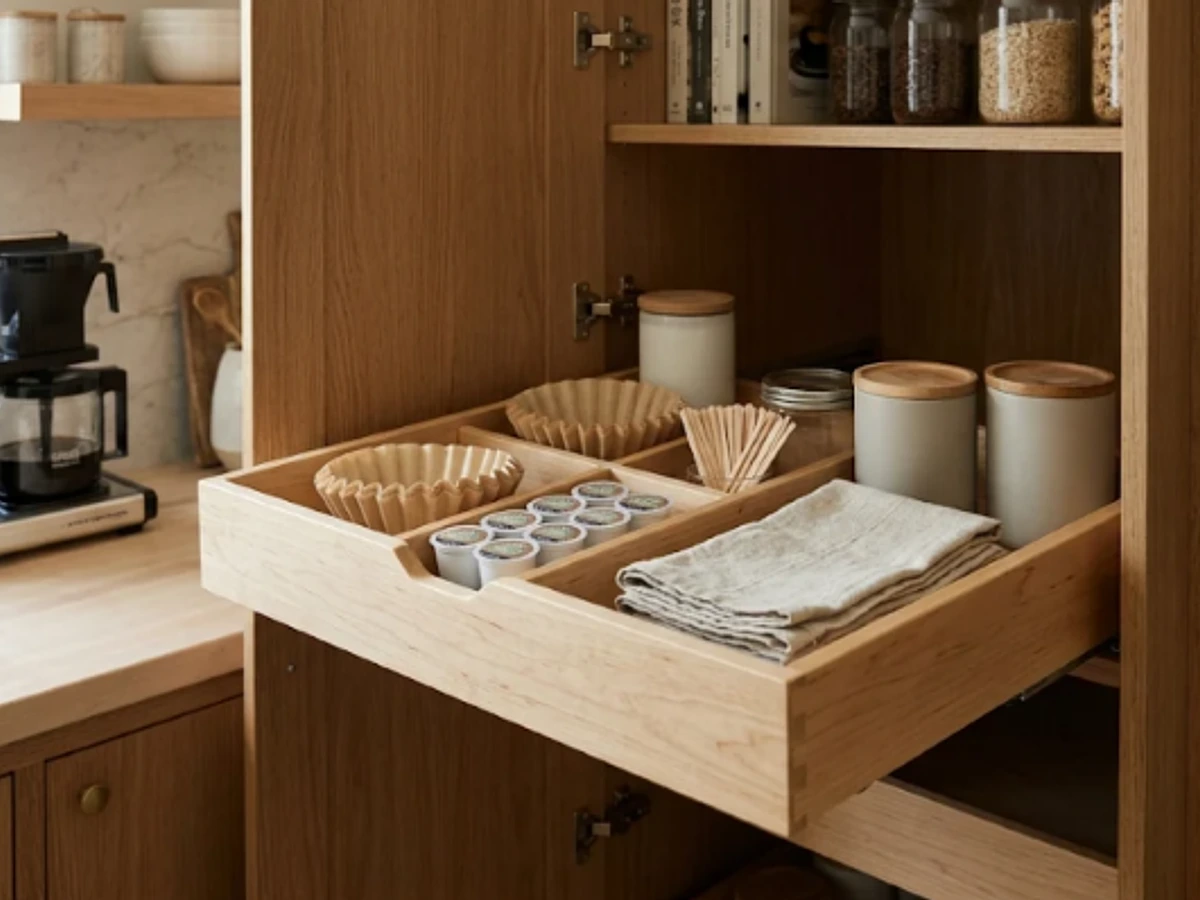
Idea 7: The Pantry Pull-Out Supply Shelf — concealing filters, syrups, and refills behind closed pantry doors.
The Small Brewer With a Two-Level Organizer
A compact brewer can share a narrow countertop with a little two-tier organizer. Store lightweight mugs and sealed sachets on the upper tier, and keep the lower tier for a spoon rest or coffee accessories. The important distinction is that the organizer should sit beside the appliance, not over the vents or where it blocks the water reservoir. Think of it as a miniature service station rather than a stacking trick.

Idea 8: The Small Brewer With a Two-Level Organizer — narrow dual-tier shelving doubling vertical counter efficiency.
Open Shelves With a Calm Coffee Display
Two short floating shelves can make the coffee corner look intentional, especially when they repeat a wood tone already used in the kitchen. Keep open shelves selective: a few matching cups, one airtight bean container, and a small piece of pottery. Store extra mugs and supplies behind cabinet doors. This keeps the eye focused on useful objects and reduces dusting.

Idea 9: Open Shelves With a Calm Coffee Display — restrained ceramic pottery and airtight glass bean jars on oak ledges.
The Portable Renter-Friendly Coffee Kit
A coffee station does not have to be fixed to the wall. Use a lidded supply box, a small washable mat, and a few matching cups so the whole setup can be packed away when the counter is needed for cooking. A manual pour-over brewer or French press is especially easy to store. This approach lets you test your preferred location before committing to shelves or furniture.

Idea 10: The Portable Renter-Friendly Coffee Kit — a modular wooden caddy and pour-over kit that packs away easily.
A Recessed Wood-Lined Coffee Niche
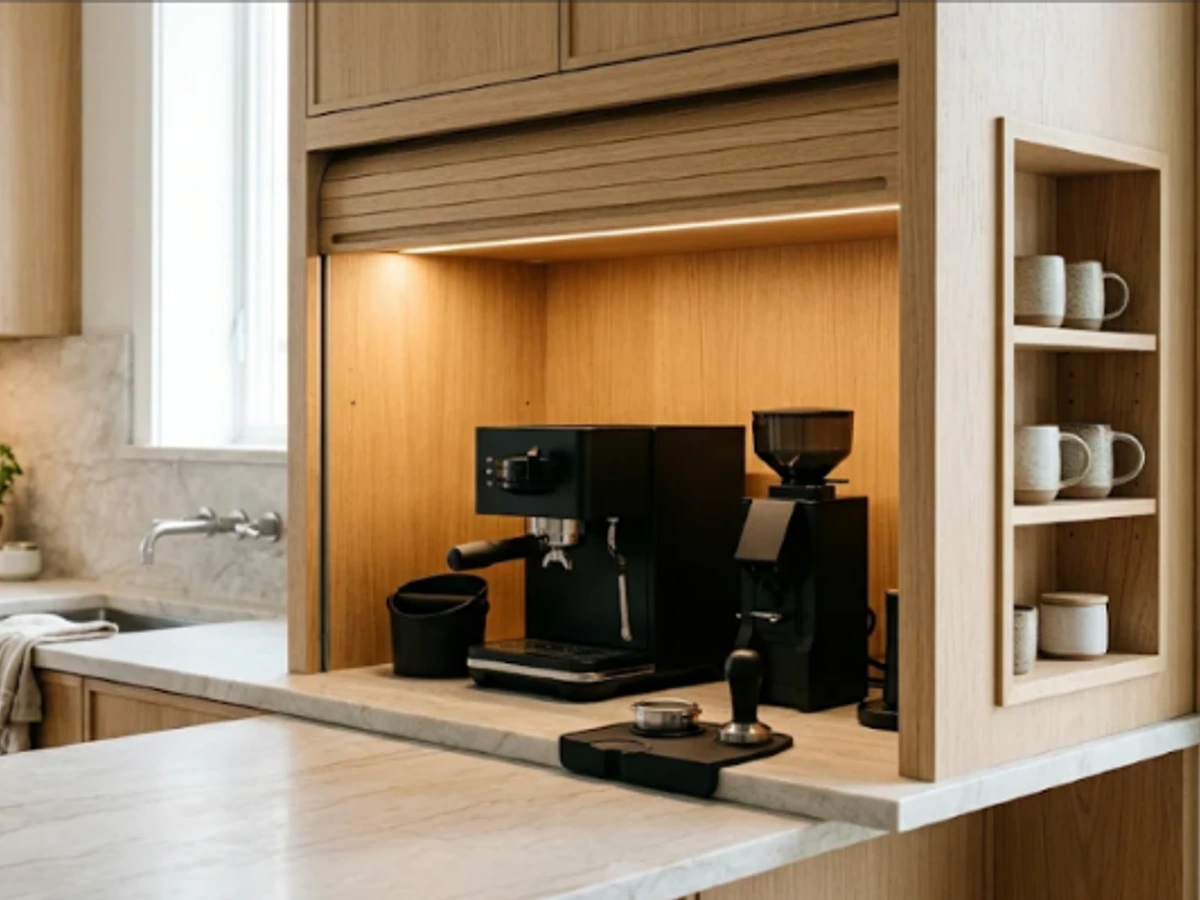
A recessed niche can be both practical and architectural. A wood back panel warms up painted cabinetry and makes a coffee machine look purposeful rather than parked in the wrong spot. The contrasting interior also helps the area read as a separate zone, even though it occupies the same cabinet wall. Reserve a low drawer for filters and tools so the niche stays uncluttered.
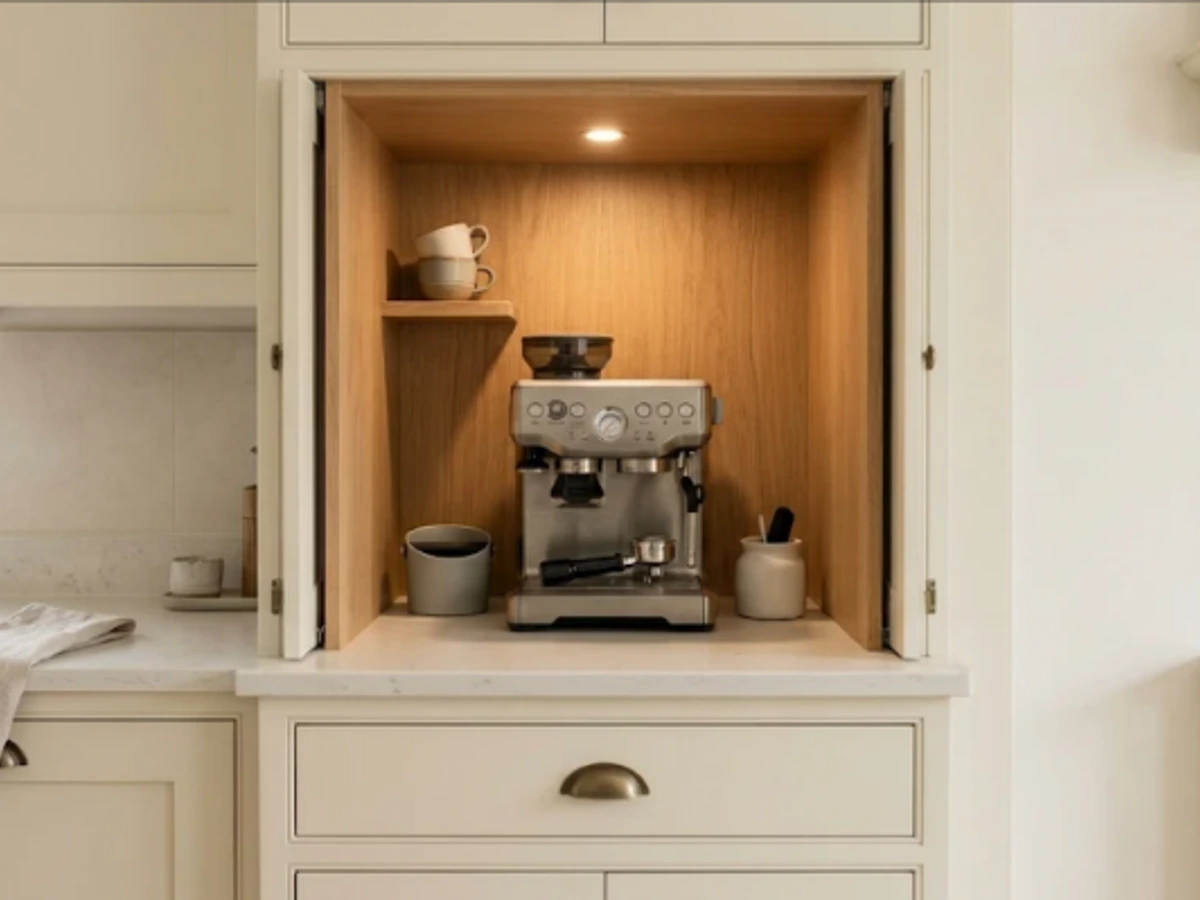
Idea 12: A Recessed Wood-Lined Coffee Niche — natural white oak cladding creating architectural contrast within painted cabinets.
The Pocket-Door Espresso Cabinet
Pocket-style cabinet doors retract out of the way during coffee making, then close to restore a calmer kitchen façade. Unlike standard hinged doors, they do not project into the work aisle. Inside, a combination of a sturdy countertop, one cup shelf, and shallow accessory drawers is often more useful than many display shelves. The design suits people who love espresso but prefer a minimalist-looking room.
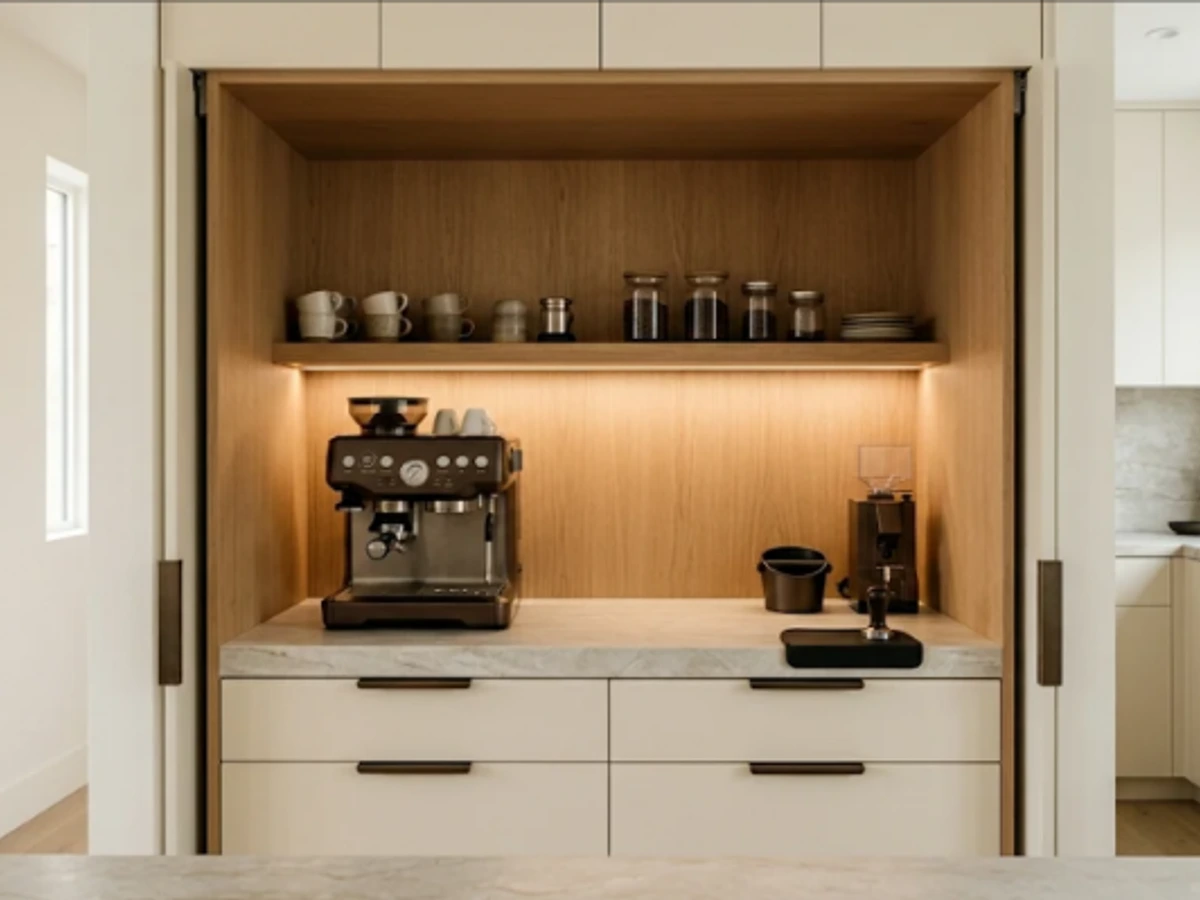
Idea 13: The Pocket-Door Espresso Cabinet — full-height doors sliding neatly into side pockets to preserve kitchen aisle flow.
A Dedicated Coffee-Tools Drawer
Sometimes the best upgrade is invisible. Use a divided drawer directly below the brewer for tampers, measuring spoons, filters, cleaning brushes, and unopened sachets. Each tool gets a predictable home, so the counter can stay clear except for the machine. A custom insert looks polished, but adjustable dividers or small washable bins do the same job.
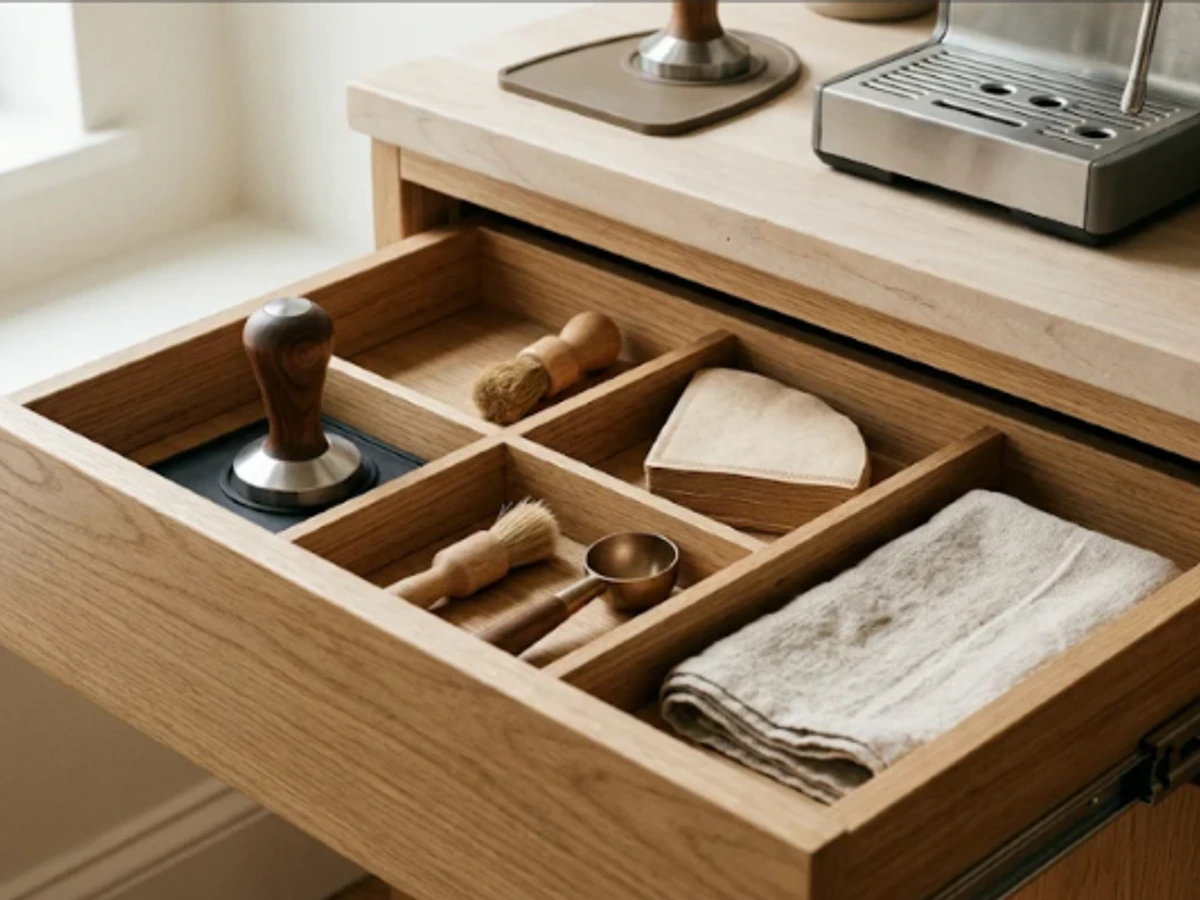
Idea 14: A Dedicated Coffee-Tools Drawer — custom wooden dividers giving tampers, filters, and brushes dedicated compartments.
A Pull-Out Espresso Work Surface
An engineered pull-out shelf adds temporary preparation space when the main counter is busy. It can hold an empty cup, scale, or brewing tools while you prepare coffee, then slide away afterward. For a heavy espresso machine, a simple shelf is not automatically suitable: support, extension load, vibration, clearance, and electrical routing all need proper planning.
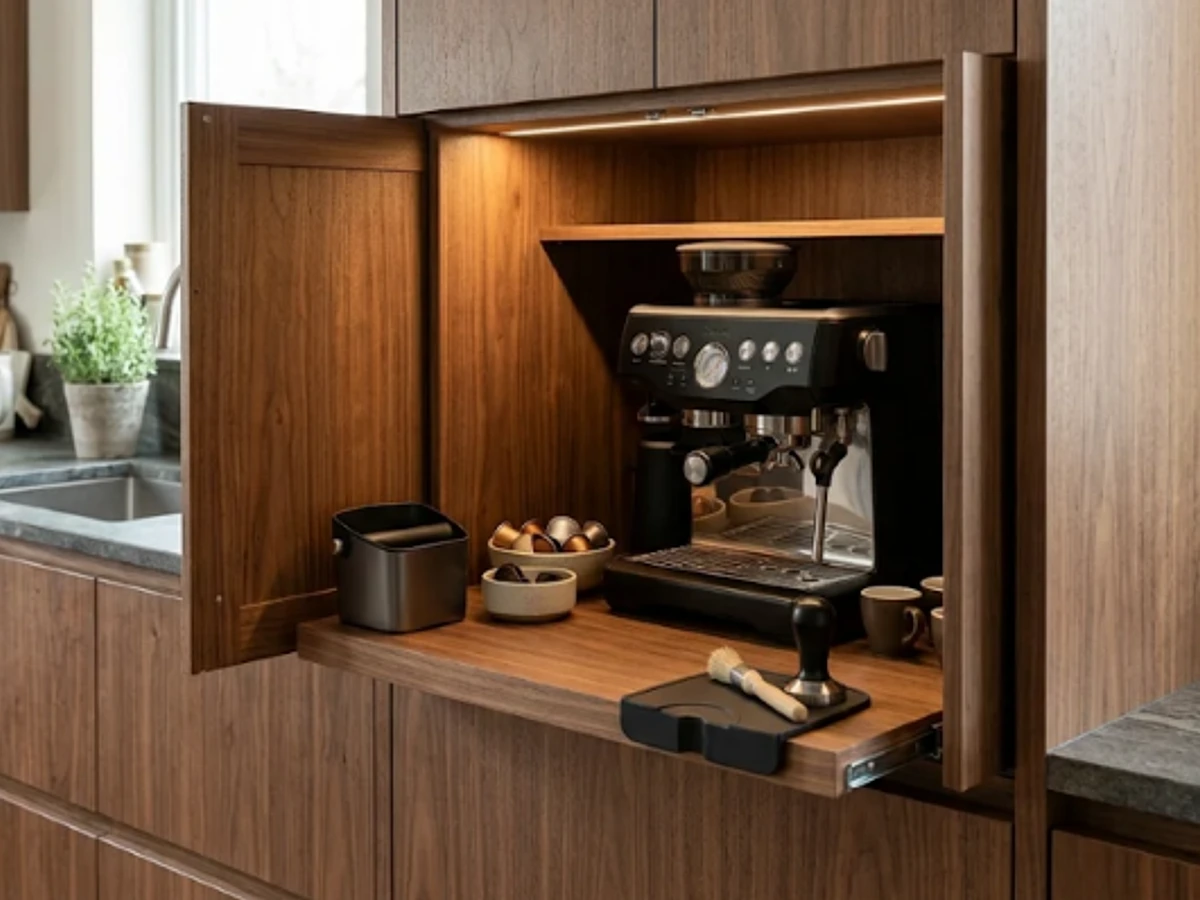
Idea 15: A Pull-Out Espresso Work Surface — heavy-duty undermount slides extending prep space during morning rushes.
The Full-Height Beverage Wall
A beverage wall groups coffee, tea, cups, and possibly a compact refrigerator into one part of the kitchen. That can stop family members crossing the main cooking area just to make a drink. The strongest layouts put frequently used cups near the machine and keep unopened supplies in taller cabinets. Matching door fronts make the wall feel part of the kitchen rather than an added collection of appliances.
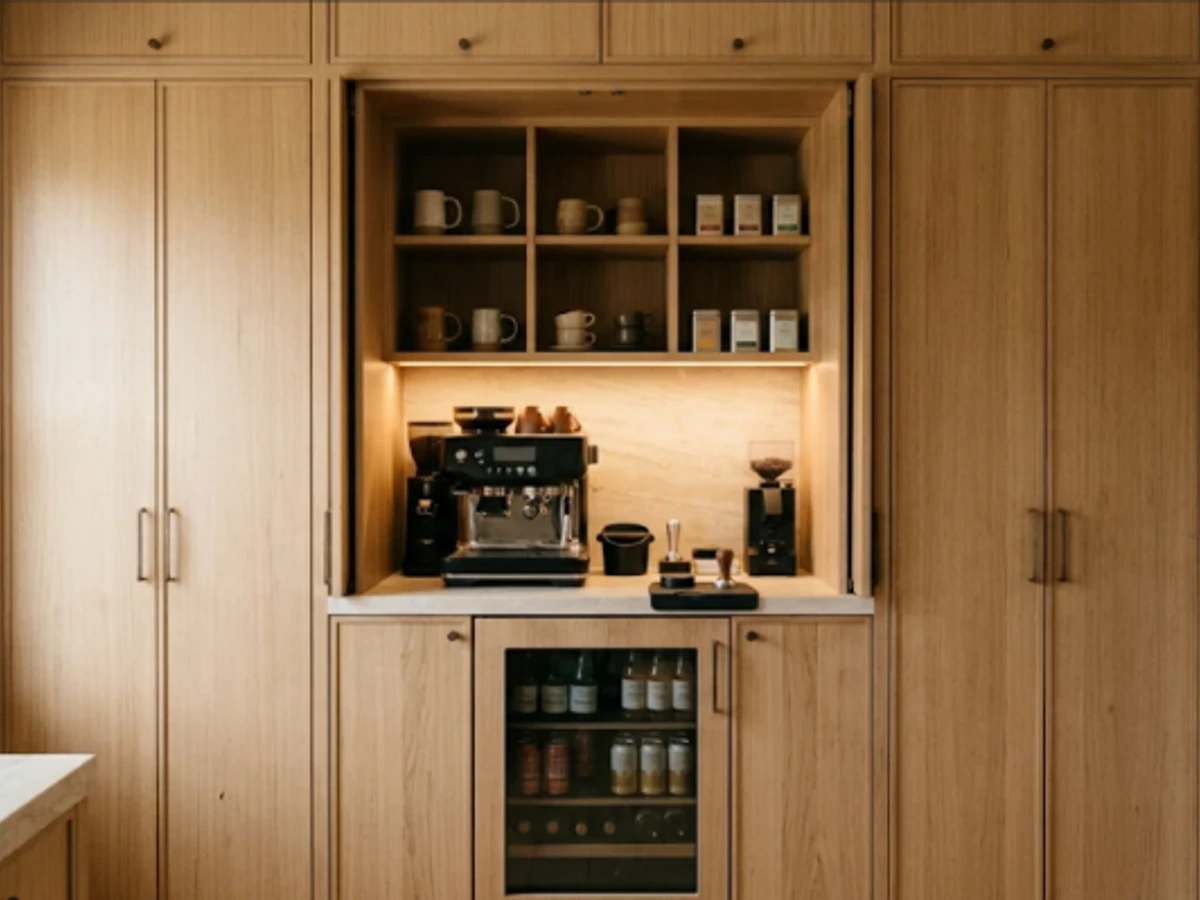
Idea 16: The Full-Height Beverage Wall — floor-to-ceiling millwork with integrated undercounter beverage refrigeration.
The Kitchen Island End-Cap Coffee Spot
A wide kitchen island may have a low-traffic end that can serve as a small beverage zone. Keep it at the edge nearest the breakfast seating, not beside the stove or the main food-prep path. A compact machine and one tray can be enough. This layout works especially well when guests can serve themselves without entering the busy cooking triangle.

Idea 17: The Kitchen Island End-Cap Coffee Spot — keeping morning beverage traffic outside the primary culinary work triangle.
The Walk-In Pantry Coffee Retreat
A walk-in pantry can absorb the grinder, brewing supplies, and mug collection that would otherwise occupy the main kitchen. A modest counter with a task light makes the setup comfortable, while shelves above hold refills. The benefit is less visual clutter in the kitchen, not necessarily a more elaborate machine. You still want water, cleanup supplies, and safe electrical access close at hand.
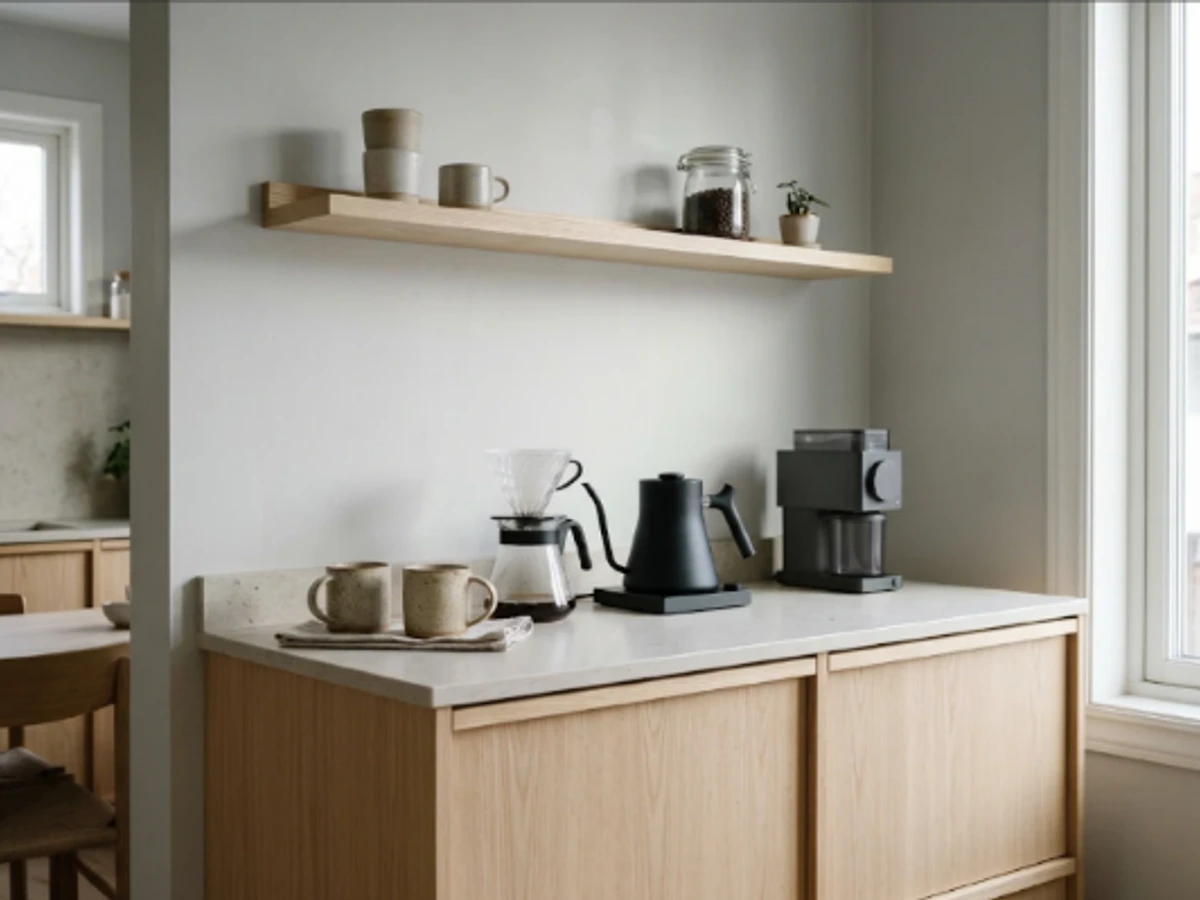
Idea 18: The Walk-In Pantry Coffee Retreat — quiet morning brewing tucked away inside an airy walk-in pantry.
A Classic Breakfast Hutch Coffee Station
A furniture-inspired hutch brings the softness of a dining room into the kitchen. Lower drawers hide spare cups and filters while a shallow upper shelf displays a few everyday mugs. Choose a finish that repeats the surrounding cabinetry, or use a subtle contrast such as muted sage against warm white. It is a timeless option for people who want a coffee bar that reads as furniture.
Idea 19: A Classic Breakfast Hutch Coffee Station — soft sage painted wood cabinetry styled like freestanding heritage furniture.
The Coffee-and-Tea Shared Station
Not everyone drinks the same morning beverage. Divide a single counter zone into two small routines: coffee beans and brewing tools on one side, tea tins and infusers on the other. Keep a kettle and cups in the middle only if the layout safely allows it. This approach is particularly practical in households where one person wants a cappuccino and another wants green tea.

Idea 20: The Coffee-and-Tea Shared Station — balanced side-by-side arrangement serving espresso and loose-leaf tea rituals.
Warm-Oak Scandinavian Coffee Corner
If you want a soothing kitchen coffee station, work with pale oak, soft white, and simple stoneware. Keep the shape language uncomplicated: one round tray, two mugs, a compact machine, and perhaps a small framed print placed beyond splashes. This look depends more on restraint and repeat materials than on buying a full matching collection.

Idea 21: Warm-Oak Scandinavian Coffee Corner — pale oak textures, linen neutrals, and tactile stoneware cups.
A Moody Dark Espresso Bar
Charcoal cabinetry, a deep green back panel, or a dark stone-look backsplash can make the coffee zone feel like a small café after hours. Contrast keeps it from looking flat: try a stainless machine, warm wood shelf, and a small pool of task light. This style suits a dedicated nook better than covering every wall of a tiny kitchen in the same dark finish.

Idea 22: A Moody Dark Espresso Bar — deep forest green cabinetry, warm brass sconces, and dark stone surfaces.
A Vintage Thrifted Home Café
The charm of a vintage coffee corner comes from objects with a little history: a secondhand wooden tray, mismatched ceramic cups, an old-fashioned sugar bowl, or a framed café print. Limit the collection so the countertop can still do its job. A thrifted dresser or cabinet can become a coffee area, but only if its structure and top surface are appropriate for the equipment used.
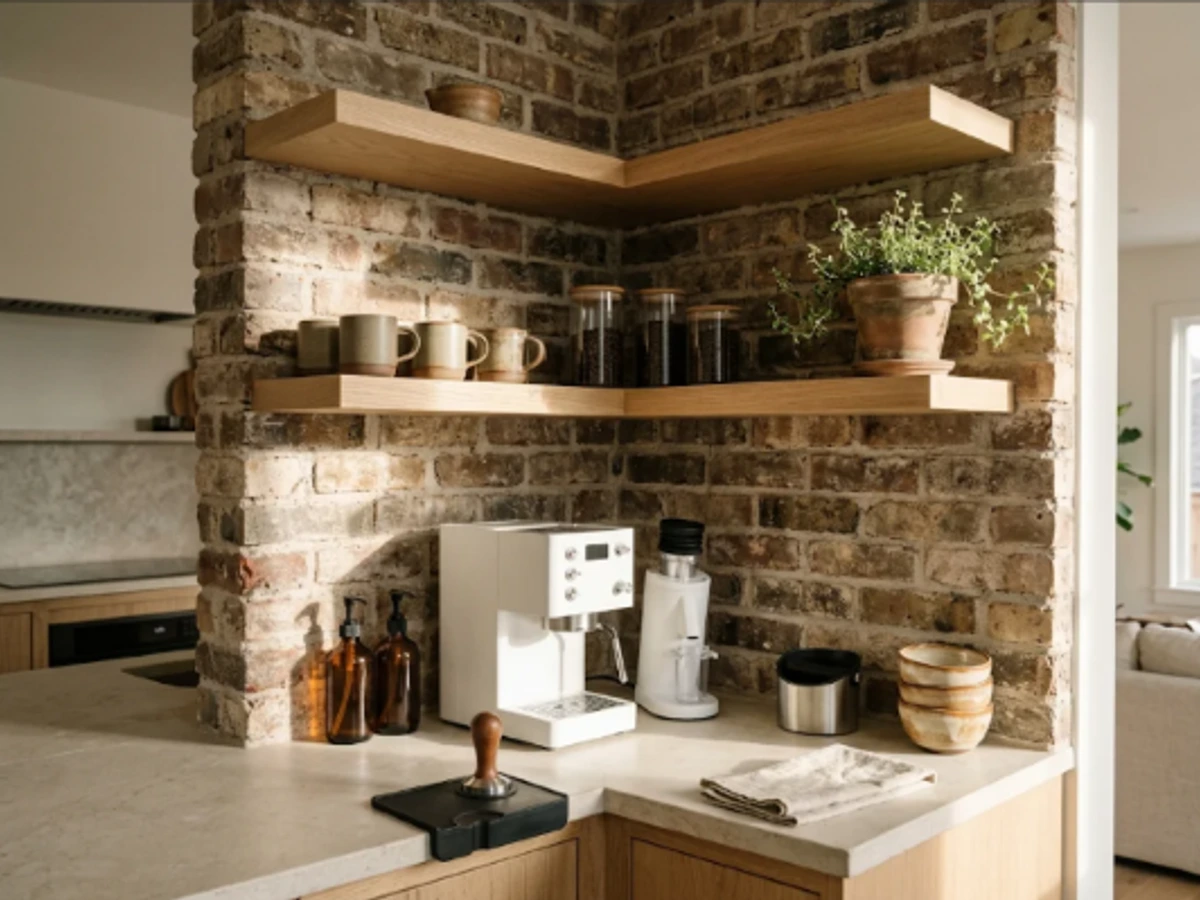
Idea 23: A Vintage Thrifted Home Café — restored oak sideboard, amber glass jars, and collected heritage ceramics.
The Soft Cottagecore Coffee Nook
A cottage-inspired station feels welcoming with painted wood, floral textiles, and pottery in gentle colors. Try a narrow gingham runner beneath the dry accessory area, a small pitcher of flowers away from electrical equipment, and a few open shelves for mugs. Keep the setup practical enough that you can wipe it down quickly after splashes.

Idea 24: The Soft Cottagecore Coffee Nook — butter yellow cupboards, gingham accents, and handmade tile backsplash.
The Modern Farmhouse Coffee Shelf
Modern farmhouse styling works best when the elements are restrained: wood, warm whites, matte black hardware, and one simple shelf. Choose a straightforward brewer, store beans in an opaque canister, and let the mugs provide the pattern. Avoid filling every inch with signs or decorative slogans; an uncluttered surface makes the station feel more contemporary.
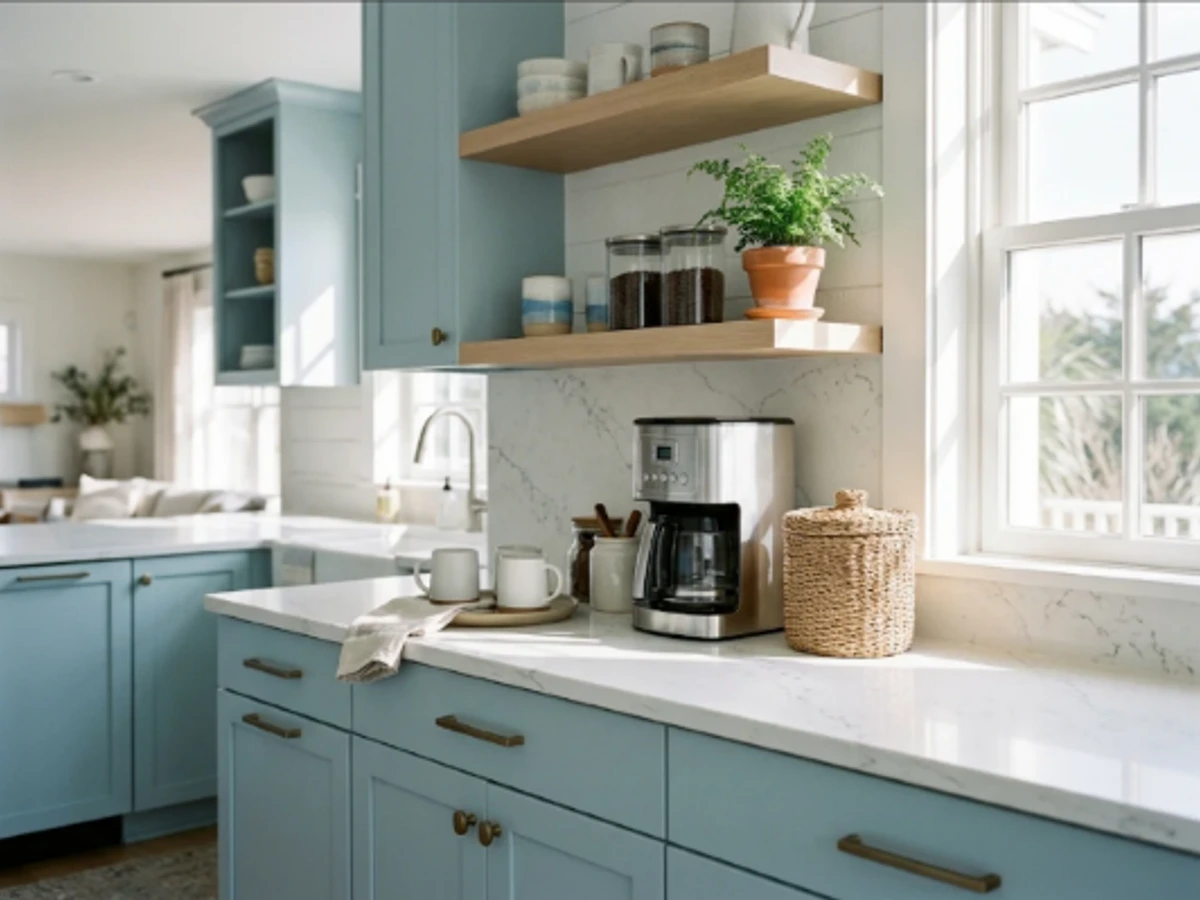
Idea 25: The Modern Farmhouse Coffee Shelf — matte black accents, white Shaker cabinetry, and clean floating timber.
The Mediterranean Terracotta Nook
Warm clay, olive tones, and tactile ceramics give a coffee station a relaxed Mediterranean character. A terracotta-colored backsplash or small painted niche pairs beautifully with warm wood shelving and a stainless moka pot. Keep the visual story focused on two or three materials rather than layering too many decorative patterns.

Idea 26: The Mediterranean Terracotta Nook — terracotta zellige tiles, olive ceramics, and warm morning light.
The Monochrome Minimalist Station
A monochrome coffee bar can look exceptionally tidy without expensive cabinetry. Pick one dominant tone—soft white, black, or greige—and repeat it through the cups, containers, and accessories. Keep labels subtle and choose closed storage for anything colorful. The everyday routine should be visible, not the packaging.
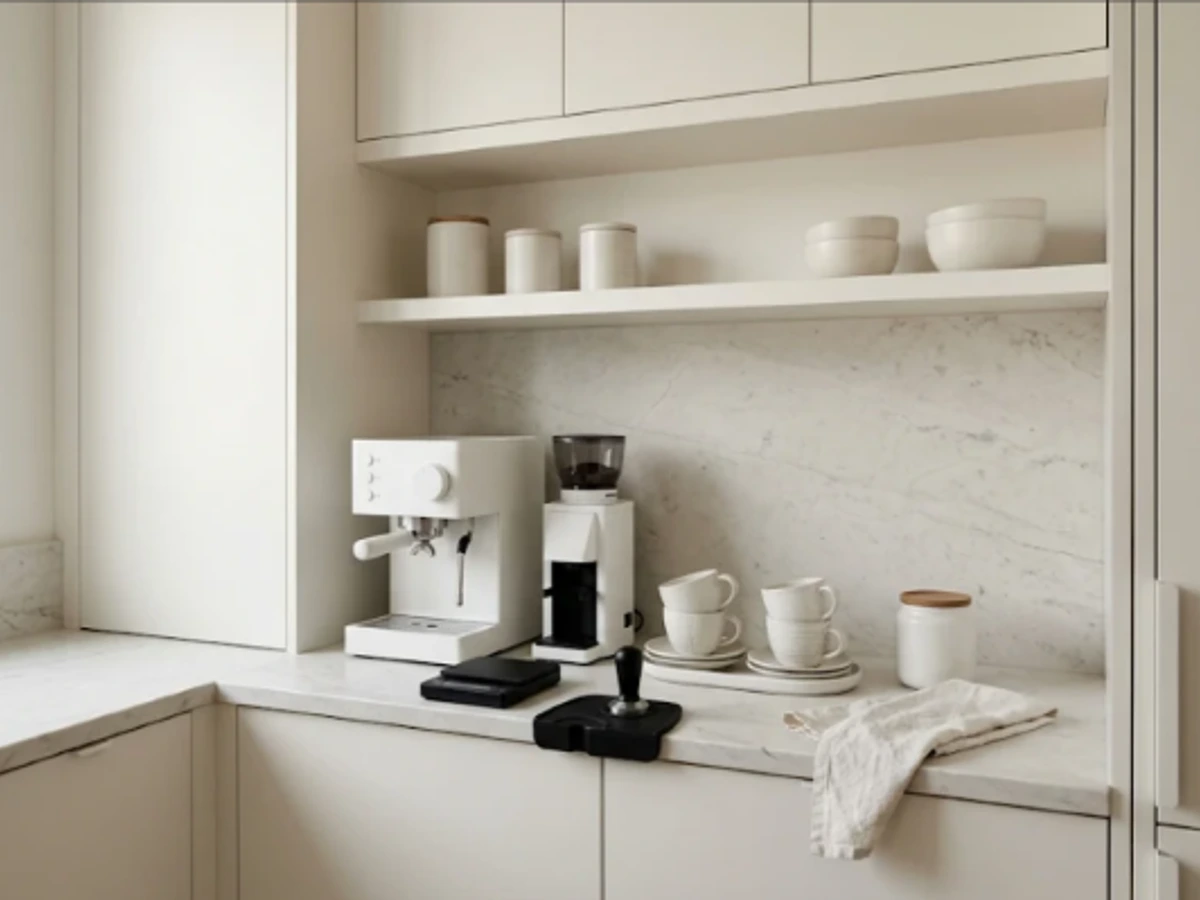
Idea 27: The Monochrome Minimalist Station — tonal off-white palette with clean flat-panel cabinetry and precision digital scale.
Brass-and-Stone Boutique Coffee Bar
A boutique-hotel feel does not require a full remodel. Combine a compact machine with a stone-look tray, warm brass-toned hardware, and one neatly framed piece of art. The effect comes from texture and intentional spacing, not a shelf full of expensive accessories. Choose easy-clean surfaces where milk and coffee will splash.
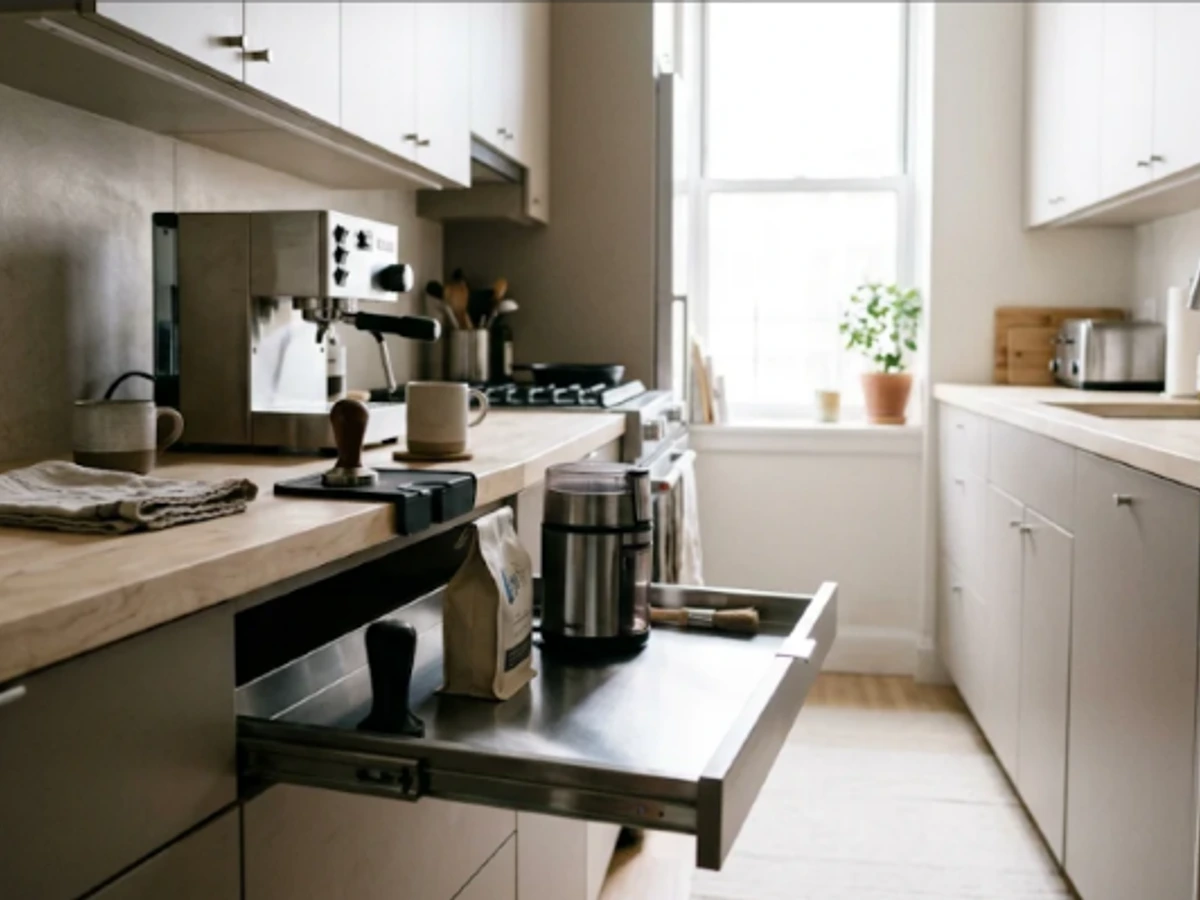
Idea 28: Brass-and-Stone Boutique Coffee Bar — honed travertine backsplash, brass details, and boutique hotel styling.
A Playful Retro Color-Pop Station
A coffee corner is a manageable place to try color without changing the entire kitchen. A mint-green canister, coral mugs, or a butter-yellow appliance can become the focal point against neutral cabinetry. Choose one main color and one supporting hue; the rest of the objects can stay quiet. This creates a lively, personal space rather than a mismatched collection.
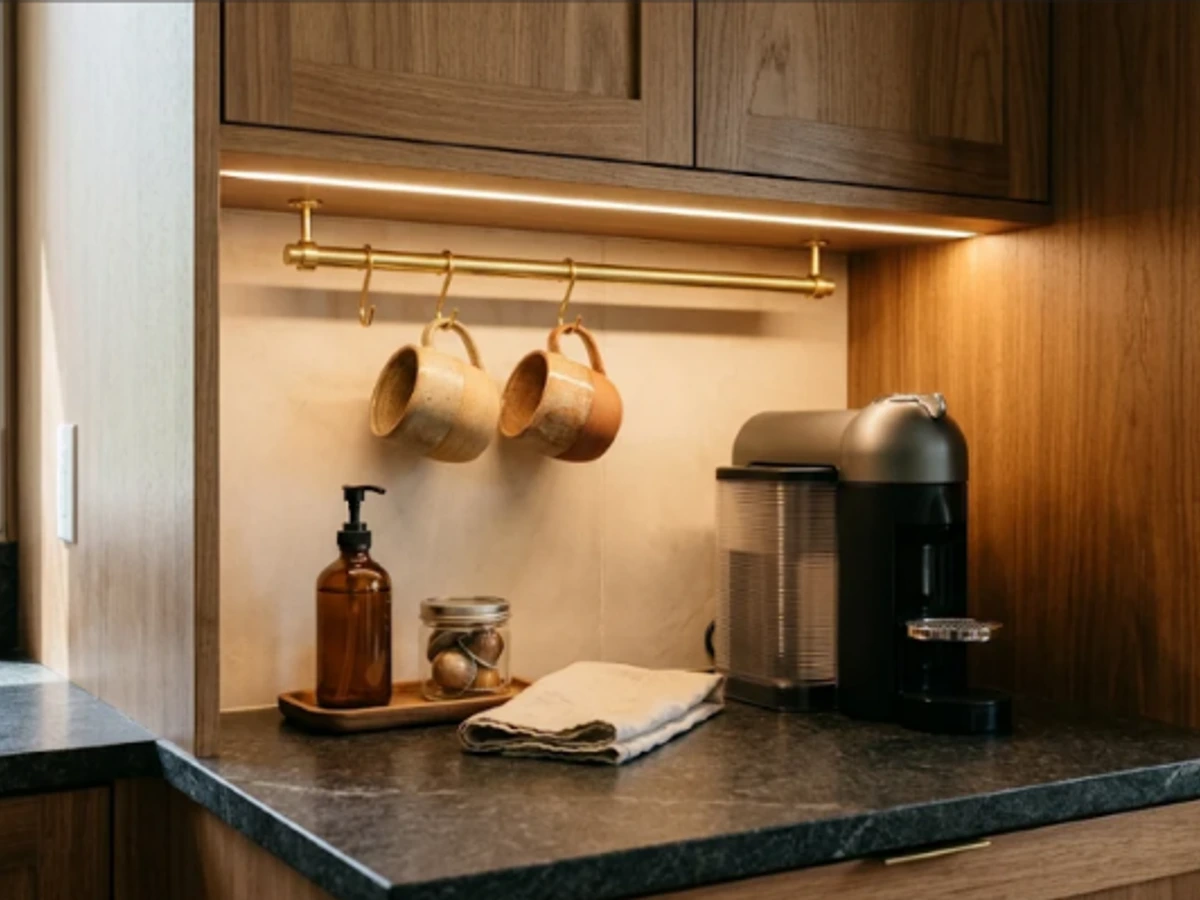
Idea 29: A Playful Retro Color-Pop Station — mint green brewer, coral accents, and cheerful mid-century ceramic accents.
A Guest-Ready Coffee and Hot-Cocoa Bar
A flexible station can serve weekday coffee and become a little drink bar when friends visit. Keep coffee equipment in its normal place, then bring out a lidded box of cocoa mix, marshmallows, cinnamon, and spare mugs for special occasions. A simple handwritten menu card can be fun, but keep wet ingredients refrigerated and perishable toppings out only while serving.
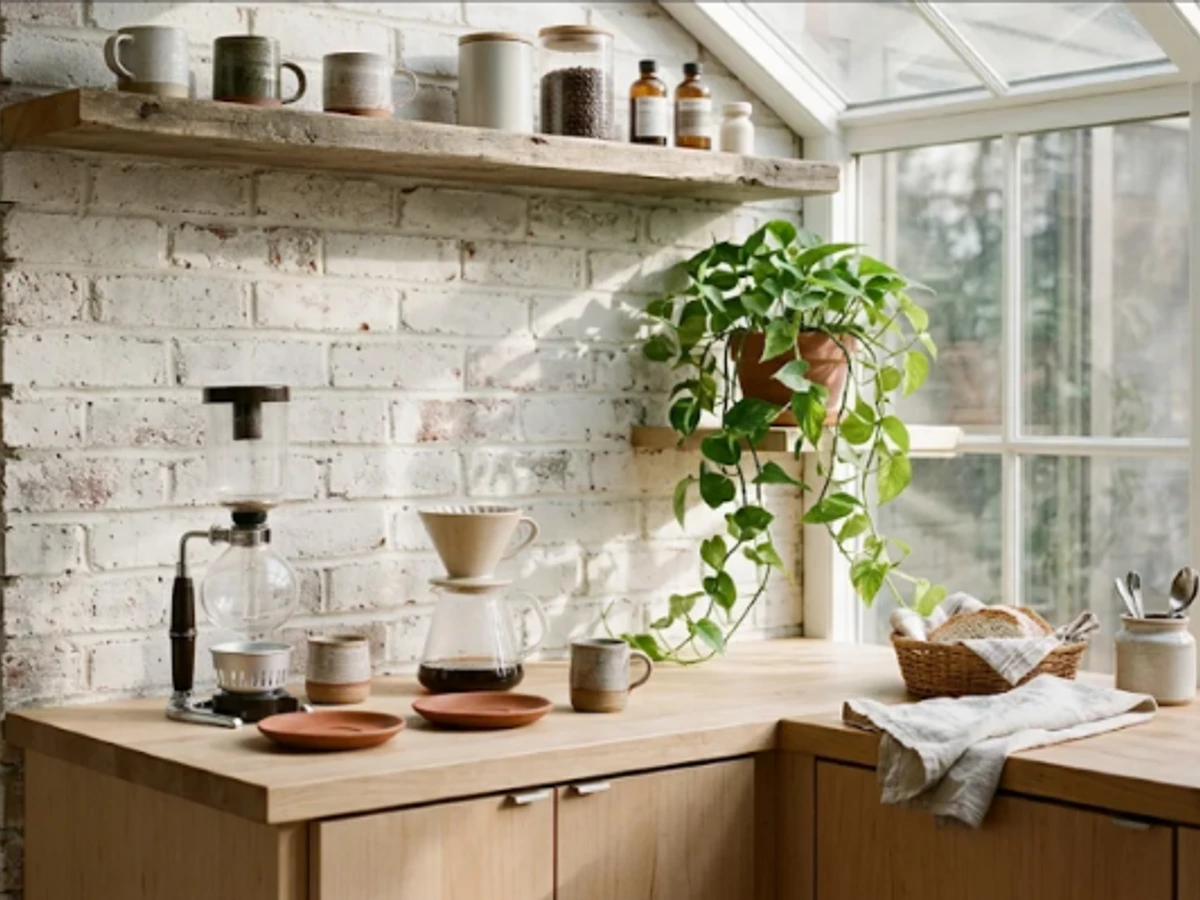
Idea 30: A Guest-Ready Coffee and Hot-Cocoa Bar — festive holiday drink entertaining with cocoa toppings and cozy mugs.
How to Set Up a Coffee Station That Stays Organized
A beautiful coffee bar is only useful if it makes daily brewing easier. Before you shop or install shelves, map out the workflow in this order:
- 1Choose the brewing method. A pour-over dripper needs much less permanent space than an espresso machine and grinder. Start with what you actually use.
- 2Measure the operating space. Allow room to fill water, lift lids, move a portafilter, and remove the drip tray. An appliance that fits under a cabinet may still be awkward to operate there.
- 3Keep supplies within one step. Place daily mugs, coffee, filters, and a spoon close to the brewer. Put backups and occasional serving pieces farther away.
- 4Plan the electrical and cleaning details. Plug in according to the manufacturer’s instructions. Keep access to the sink, bin, and a washable surface. Have an electrician assess changes to outlets or built-in cabinetry.
- 5Choose one visual style. Repeat two or three finishes—such as oak, cream, and black—to make the setup feel considered without needing decorative clutter.
- 6Edit after a week. If you have to move a vase every morning or reach behind a machine for filters, change the layout. The best coffee station reflects your routine.
A Simple Shopping Checklist
You may already own most of the essentials. Start with a reliable brewer, everyday cups, an airtight container for coffee, and a small bin or drawer for supplies. Then consider a washable tray, good task lighting, or a few sturdy hooks if the space needs them. Specialty cabinetry, refrigerated milk storage, and decorative extras are optional.
- Core Essentials: Brewer or espresso machine, airtight bean canister, 2–4 daily ceramic mugs, teaspoon/tamper rest.
- Functional Upgrades: Low-rim washable tray (wood, stone, or composite), divided shallow drawer insert, under-cabinet warm LED lighting strip.
- Display Accents (Optional): Short floating timber shelf, brass wall rail with S-hooks, artisanal stoneware pitcher for stirring spoons.
Choose Your Budget Approach
| Approach | What to do | What to skip |
|---|---|---|
| Use what you own | Group the brewer, mugs, and beans on an existing counter | New furniture and extensive décor |
| Small DIY refresh | Add a tray, drawer organizer, suitable shelving, or task lighting | Changing electrical infrastructure yourself |
| Cabinetry upgrade | Plan a niche, appliance garage, or pantry coffee zone | Cabinet measurements before selecting the actual equipment |
Note: There is no useful one-size-fits-all dollar budget: the machine you already own, local labor rates, and whether electrical work is needed change the project considerably.
Frequently Asked Questions
Make Your Morning Coffee Ritual Feel Special
A good coffee station isn't defined by a custom cabinet or an expensive espresso machine. It's the small, repeatable pleasure of having everything ready where you need it. Start with the space you have, choose one idea that matches your routine, and add only the features you will enjoy using.
Related Editorial Stories
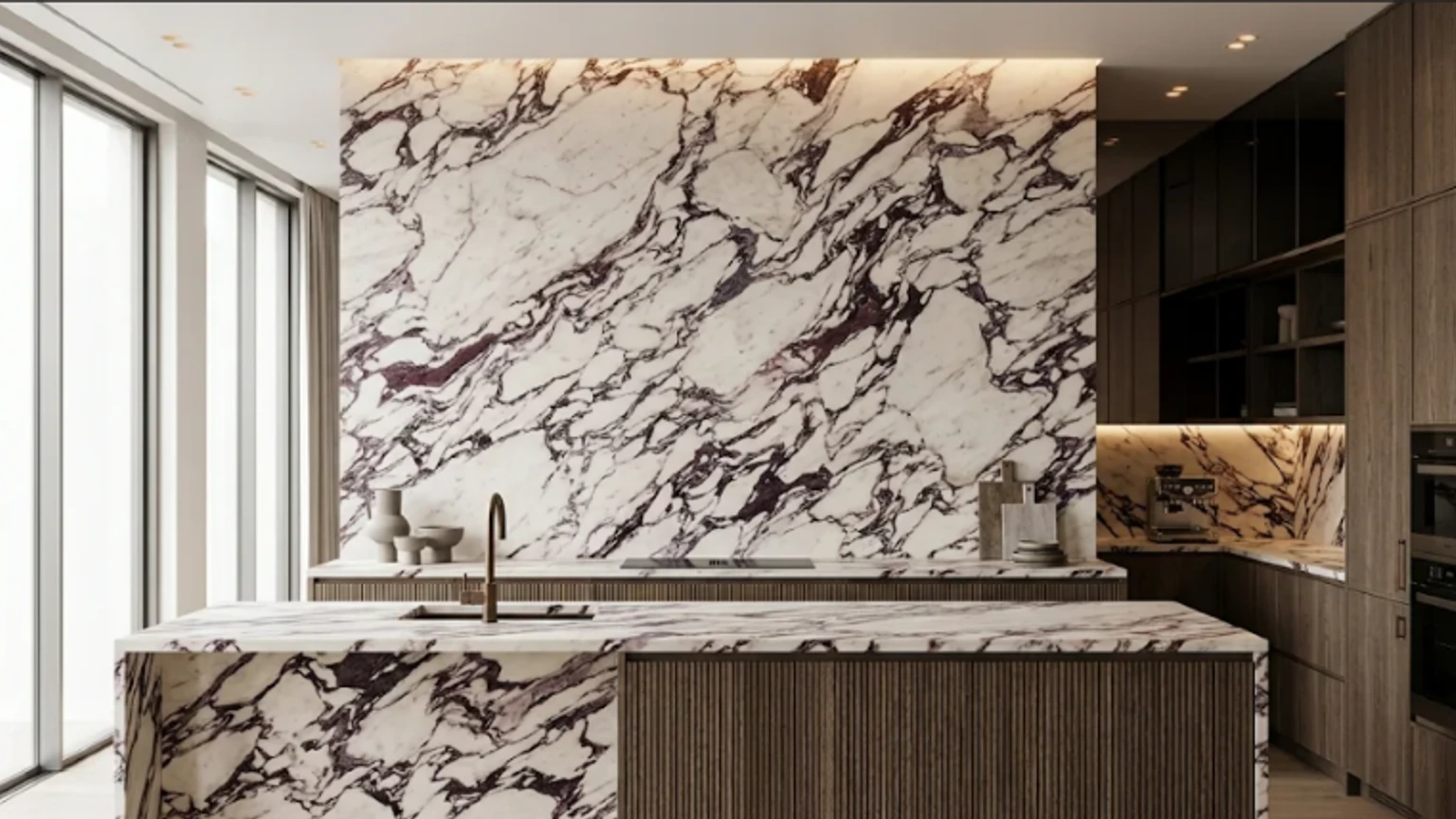
50 Kitchen Backsplash Ideas for 2027: Beautiful Designs for Every Style and Budget
Discover 50 stunning kitchen backsplash ideas for 2027: timeless subway tile, handmade zellige, dramatic marble slabs, colorful patterns, and budget-friendly updates.

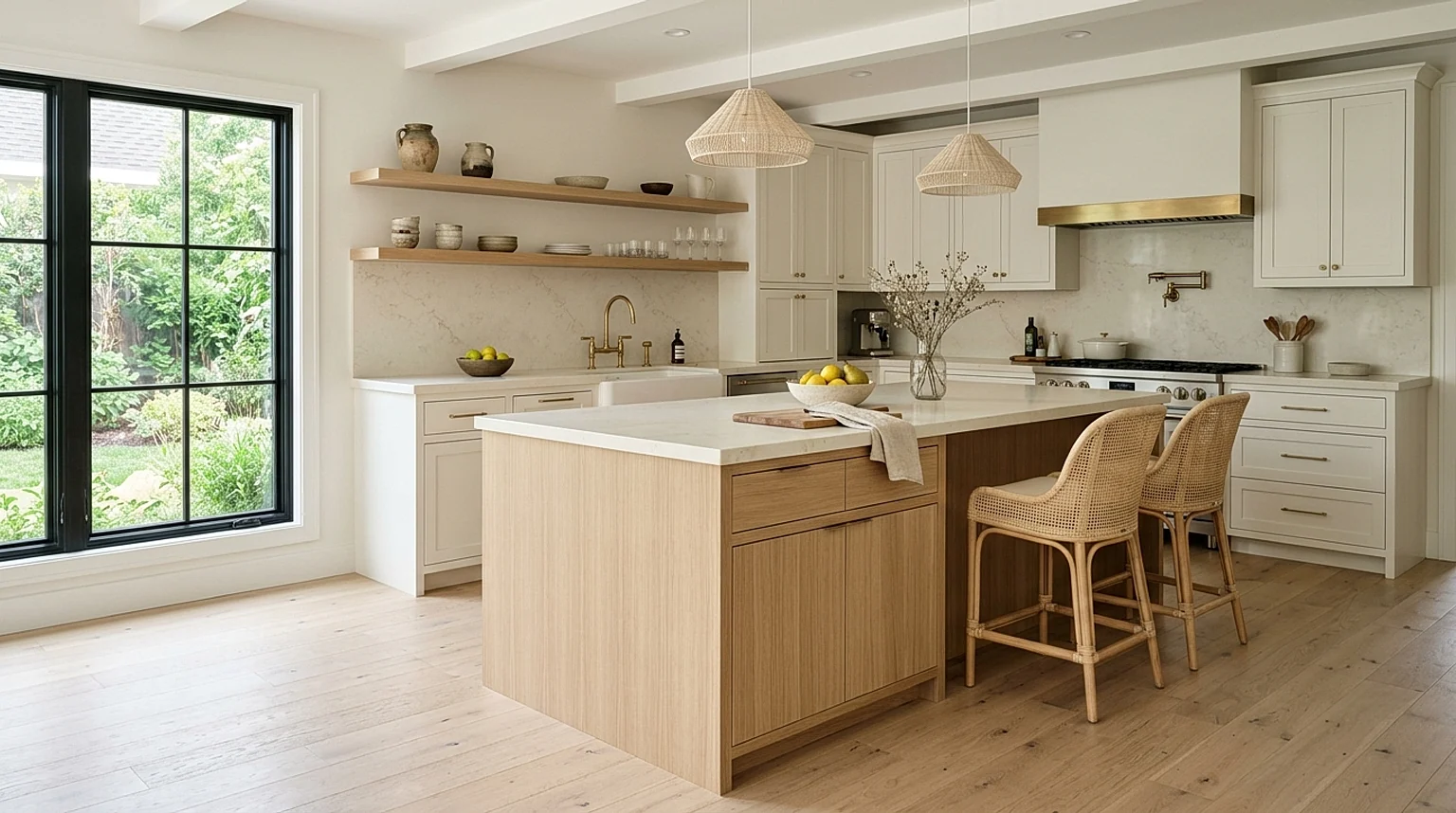
30 Kitchen Island Ideas in 2027 for Every Style, Space, and Budget
Explore 30 functional kitchen island ideas for 2027: warm white oak finishes, curved stone contours, compact rolling carts, and smart storage solutions for every layout.
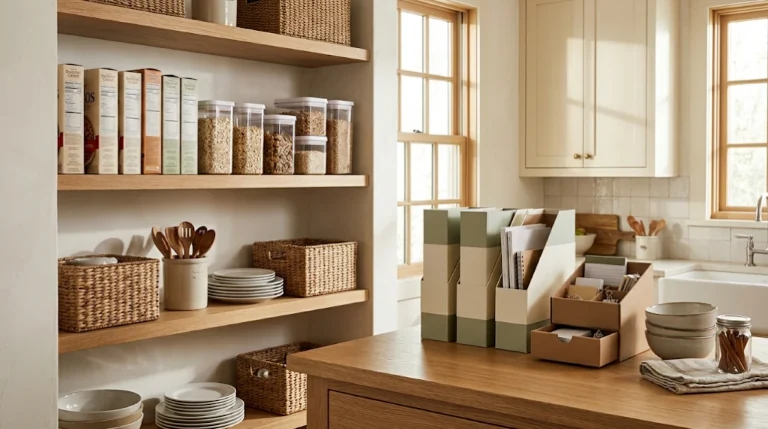
30 Cereal Box Storage Ideas in 2027: Clever DIY Organizers and Pantry Hacks
Discover 30 clever cereal box storage ideas for 2027: creative cardboard upcycling crafts, custom drawer trays, and space-saving pantry organization hacks.